Mohawk Nation News

News and Articles by kahntineta, Mohawk Nation News Publisher

Mohawk Nation News

MASS MACABRE MUSEUM INC.

MNN. JAN. 29, 2024. All North American museums depict lies  and “genocide” of the onkwehonwe, the original people of turtle island. We want back everything that was taken from us such as the wampum records that were hidden or destroyed as if we never existed. Stop displaying our skulls for profit such as Apache Geronimo’s skull stolen and being filled with whiskey for the “Skull and Bones” ritual of the graduating elite at Yale University. We want all the museum buildings so we can display the truth of the evil practices that destroyed the people of the great peace to create the U.S.”Republic of War”.

Our “hanging tobacco” have been in the shadows doing their work. The truth must be shown such as the residential school death camps, the MKULTRA experiments by the CIA and Canada, the murders of our children whose remains are now being found. 120 million original people of the Western Hemisphere were murdered by the settler colonialists. The whole truth must be displayed! Grave robbing must end! Canada must step up to the plate immediately to enact a Graves Protection Act to help us find our people. Canada’s reaction to the mass graves found in 2021 was to create the Office of the Special Interlocutor for Missing Children. Their mandate will finish next summer. We need a permanent permanent  independent onkwehonwe office for investigating the murders of our children. Although Canada has admitted genocide, there are no laws as in the US to protect our heritage?  

Leading Museums Remove Native Displays Amid New Federal Rules

https://www.yahoo.com/news/leading-museums-remove-native-displays-183325697.html

NEW YORK — The American Museum of Natural History will close two major halls exhibiting Native American objects, its leaders said on Friday, in a dramatic response to new federal regulations that require museums to obtain consent from tribes before displaying or performing research on cultural items.

Professors use actual skulls of murdered Indians to teach.

The halls we are closing are artifacts of an era when museums such as ours did not respect the values, perspectives and indeed shared humanity of Indigenous peoples,” Sean Decatur, the museum’s president, wrote in a letter to the museum’s staff on Friday morning. “Actions that may feel sudden to some may seem long overdue to others.”

The museum is closing galleries dedicated to the Eastern Woodlands and the Great Plains this weekend, and covering a number of other display cases featuring Native American cultural items as it goes through its enormous collection to make sure it is in compliance with the new federal rules, which took effect this month.

Museums around the country have been covering up displays as curators scramble to determine whether they can be shown under the new regulations. The Field Museum in Chicago covered some display cases, the Peabody Museum of Archaeology and Ethnology at Harvard University said it would remove all funerary belongings from exhibition and the Cleveland Museum of Art has covered up some cases.

But the action by the American Museum of Natural History in New York, which draws 4.5 million visitors a year, making it one of the most visited museums in the world, sends a powerful message to the field. The museum’s anthropology department is one of the oldest and most prestigious in the United States, known for doing pioneering work under a long line of curators including Franz Boas and Margaret Mead. The closures will leave nearly 10,000 square feet of exhibition space off-limits to visitors; the museum said it could not provide an exact timeline for when the reconsidered exhibits would reopen.

Some objects may never come back on display as a result of the consultation process,” Decatur said in an interview. “But we are looking to create smaller-scale programs throughout the museum that can explain what kind of process is underway.”

The changes are the result of a concerted effort by the Biden administration to speed up the repatriation of Native American remains, funerary objects and other sacred items. The process started in 1990 with the passage of the Native American Graves Protection and Repatriation Act, or NAGPRA, which established protocols for museums and other institutions to return human remains, funerary objects and other holdings to tribes. But as those efforts have dragged on for decades, the law was criticized by tribal representatives as being too slow and too susceptible to institutional resistance.

This month, new federal regulations went into effect that were designed to hasten returns, giving institutions five years to prepare all human remains and related funerary objects for repatriation and giving more authority to tribes throughout the process.

We’re finally being heard — and it’s not a fight, it’s a conversation,” said Myra Masiel-Zamora, an archaeologist and curator with the Pechanga Band of Indians.

Even in the two weeks since the new regulations took effect, she said, she has felt the tenor of talks shift. In the past, institutions often viewed Native oral histories as less persuasive than academic studies when determining which modern-day tribes to repatriate objects to, she said. But the new regulations require institutions to “defer to the Native American traditional knowledge of lineal descendants, Indian Tribes and Native Hawaiian organizations.”

We can say, ‘This needs to come home,’ and I’m hoping there will not be pushback,” Masiel-Zamora said.

Museum leaders have been preparing for the new regulations for months, consulting lawyers and curators and holding lengthy meetings to discuss what might need to be covered up or removed. Many institutions are planning to hire staff to comply with the new rules, which can involve extensive consultations with tribal representatives.

The result has been a major shift in practices when it comes to Native American exhibitions at some of the country’s leading museums — one that will be noticeable to visitors.

At the American Museum of Natural History, segments of the collection once used to teach students about the Iroquois, Mohegans, Cheyenne, Arapaho and other groups will be temporarily inaccessible. That includes large objects, like the birchbark canoe of Menominee origin in the Hall of Eastern Woodlands, and smaller ones, including darts that date as far back as 10,000 B.C. and a Hopi Katsina doll from what is now Arizona. Field trips for students to the Hall of Eastern Woodlands are being rethought now that they will not have access to those galleries.

What might seem out of alignment for some people is because of a notion that museums affix in amber descriptions of the world,” Decatur said. “But museums are at their best when they reflect changing ideas.”

Exhibiting Native American human remains is generally prohibited at museums, so the collections being reassessed include sacred objects, burial belongings and other items of cultural patrimony. As the new regulations have been discussed and debated over the past year or so, some professional organizations, such as the Society for American Archaeology, have expressed concern that the rules were reaching too far into museums’ collection management practices. But since the regulations went into effect on Jan. 12, there has been little public pushback from museums.

Much of the holdings of human remains and Native cultural items were collected through practices that are now considered antiquated and even odious, including through donations by grave robbers and archaeological digs that cleared out Indigenous burial grounds.

This is human rights work, and we need to think about it as that and not as science,” said Candace Sall, the director of the museum of anthropology at the University of Missouri, which is still working to repatriate the remains of more than 2,400 Native American individuals. Sall said she added five staff members to work on repatriation in anticipation of the regulations and hopes to add more.

Criticism of the pace of repatriation had put institutions such as the American Museum of Natural History under public pressure. In more than 30 years, the museum has repatriated the remains of approximately 1,000 individuals to tribal groups; it still holds the remains of about 2,200 Native Americans and thousands of funerary objects. (Last year, the museum said it would overhaul practices that extended to its larger collection of some 12,000 skeletons by removing human bones from public display and improving the storage facilities where they are kept.)

A top priority of the new regulations, which are administered by the Interior Department, is to finish the work of repatriating the Native human remains in institutional holdings, which amount to more than 96,000 individuals, according to federal data published in the fall.

The government has given institutions a deadline, giving them until 2029 to prepare human remains and their burial belongings for repatriation.

In many cases, human remains and cultural objects have little information attached to them, which has slowed repatriation in the past, especially for institutions that have sought exacting anthropological and ethnographic evidence of links to a modern Native group.

Now the government is urging institutions to push forward with the information they have, in some cases relying solely on geographical information — such as what county the remains were discovered in.

There have been concerns among some tribal officials that the new rules will result in a deluge of requests from museums that may be beyond their capacities and could create a financial burden.

Speaking in June to a committee that reviews the implementation of the law, Scott Willard, who works on repatriation issues for the Miami Tribe of Oklahoma, expressed concern that the rhetoric regarding the new regulations sometimes made it sound as if Native ancestors were “throwaway items.”

This garage sale mentality of ‘give it all away right now’ is very offensive to us,” Willard said.

The officials who drew up the new regulations have said that institutions can get extensions to their deadlines as long as the tribes that they are consulting with agree, emphasizing the need to hold institutions accountable without overburdening tribes. If museums are found to have violated the regulations, they could be subject to fines.

Bryan Newland, the assistant secretary for Indian Affairs and a former tribal president of the Bay Mills Indian Community, said the rules were drawn up in consultation with tribal representatives, who wanted their ancestors to recover dignity in death.

Repatriation isn’t just a rule on paper,” Newland said, “but it brings real meaningful healing and closure to people.”

c.2024 The New York Times Company

Michael Jackson’s “Thriller” is an illustration of how scared our innocent  and unaware youngsters must have been after being kidnapped and placed in the residential schools of horror run by the settler colonialists and the churches:

 mohawknationnews.com kahentinetha2@protonmail.com

MohawkMothers.ca

kahnistensera@riseup.net

box 911 kahnawake que. canada J0L 1B0 

CONTESTED SOVEREIGNTIES @ RVH/MCGILL UNIVERSITY

MNN. Jan. 24, 2024. Please Post & Distribute.

A cool young kanienkehaka [Mohawk] McGill student wrote this. Pictures were added by MNN:

TITLE: “A Landscape of Contested Sovereignties: Fissure Points Arising from the Archaeological

Investigation at the Old Royal Victoria Hospital in Montreal, Quebec

 by Dallas Karonhianoron Canady

ID: 260987251

Dr. Peter Johansen

ANTH 450: Archaeology of Landscapes

10 December 2023 Canady 1

TIME FOR INDIGENOUS TRUTH

We shall resist by every means any aggression, any violation of the treaties, any disturbance of our people in the free use and enjoyment of our land, any usurpation of our sovereignty, any encroachment and oppression. We pledge that the noise will be heard from one end of the world to the other.” — Louis Karoniaktajeh Hall (2023:167)

“[The] — David M. Schaepe (2009:244)

Ohèn:ton Tsi Karihwatéhkwen, Matters Before All Else

It is the summer of 2022. I’ve just finished my third year of undergraduate studies in anthropology at McGill University, but any sense of accomplishment I could have experienced was done away with following the death of my father on Easter Sunday. I’ve been bombarded with the responsibilities of handling his estate as his only child, just twenty-one years old. I spend most of my days at home, enraptured in a violent cycle of reminiscing on what used to be and catastrophizing about what my life could possibly become. Somehow, I managed to pick up a job working as a research assistant despite all of this. A professor in my department tasked me with reviewing and annotating some thirty-years worth of archaeological publications as it concerned the discipline’s engagement with Indigeneity, Indigenous peoples, and the concept of reconciliation. I finished my work in August, and it was around this time that I was put in touch with the Kanien’kehá:ka Kahnisténsera– also known as the Mohawk Mothers. They were preparing to file an injunction in Quebec’s Superior Court to stop a construction project that was going to take place on the northwestern sector of McGill’s downtown campus (Mohawk Nation News 2022).

Canady 2

Figure 1. A screenshot of a model of the Société québécoise des infrastructures (2023) buildings of the Old Royal Victoria Hospital complex.

Known as the New Vic Project, this endeavor is framed as a collaborative effort between McGill University, the City of Montreal, and the government of Quebec to refurbish the shell of a hospital in the downtown core that has been partially abandoned since 2015. “Classic patient wards and medical facilities will be reimagined and completely reinvented,” notes the university’s website (McGill 2023), as classrooms, dormitories, research labs, restaurants and green spaces. The former Royal Victoria Hospital is considered a cultural heritage property (un immobilier de patrimoine culturel) belonging to the settler state. Further, the land that the hospital was built upon– in fact the entirety of what is now called Mount Royal– is itself considered a heritage site (Culture et Communications Québec 2023). Pursuant to Quebec’s Loi sur le patrimoine culturel (2011), this means that any and all construction taking place was to be subject to, and only to, provincial oversight.

Canady 3

The Kanien’kehá:ka Kahnisténsera raised three potent issues in their application for an injunction: 1) that the land encompassing the Royal Victoria Hospital and Mount Royal fell under Mohawk jurisdiction; 2) as such, in accordance with the Kaianereh’ko:wa (Great Law of Peace) the Kahnisténsera are endowed with the responsibility of protecting the land for the future generations; and 3) also in accordance with the Kaianereh’ko:wa, the Kahnisténsera are entrusted with protecting any and all children of the past, present and future– dead or alive. They came forth with hundreds of articles of evidence detailing horrific crimes that took place at the site of the Royal Victoria Hospital throughout the 20th century, including the now infamous CIA-funded MK-Ultra brainwashing experiments (Burton 2023). Most damning is eyewitness testimony provided by a former patient, Lana Ponting, who alleges that she was institutionalized alongside Indigenous children at the hospital’s psychiatric institute and had reason to believe some of them were buried on the grounds (Annable 2020). In calling for a halt to construction, the Kanien’kehá:ka Kahnisténsera also demanded that there be an Indigenous-led archaeological investigation to protect any potential unmarked graves on the site.

The role of archaeology in this situation is a complex one. The investigation itself sits on a fragile border between historic and forensic, raising the question of how far in the past must a crime be committed in order to be considered archaeological and not punishable under state law. It is also unique in that it is the first search for unmarked graves of Indigenous children within the province of Quebec, in addition to the fact that this search is taking place at a hospital and not a former residential school site, as is the case elsewhere in Canada (Cooper 2023). But what I will focus on for the remainder of this paper is the way in which the Royal Victoria Hospital– as an archaeological site– has acted as a medium through which contested sovereignties are articulated, imagined and reified. I argue that in mobilizing the concept of, as well as legislation

Canady 4

relating to cultural heritage, the settler-colonial state of Quebec is in fact making a claim to territoriality and political legitimacy. This is consistent with the historic weaponization of archaeology against the Mohawk nation, which has and continues to be used as a means to usurp our authority and belonging to Land.

A History of Archaeology in Quebec

There are very few scholarly publications concerning themselves with the history of archaeology of Quebec, as compared to the plethora of literature available on the history of archaeology within Canada as a whole. This is despite the fact that the oldest archaeological collection in Canada consists of slate arrowheads found by early 18th-century laborers near Trois-Rivières, Quebec in the town of Bécancour (Clermont 2001:1079). What research does exist primarily concerns itself with the recent development of commercial archaeology in the province (Arpin and Bergeron 2006; Zorzin 2010; Zorzin and Gates St-Pierre 2017; Gates St-Pierre 2018). These academics have largely endorsed the view that there was simply no formal discipline in the province prior to the secularization that took place during the Quiet Revolution of the 1960s (Gates St-Pierre 2018:3; Clermont 1999:8-9). Prior to this, it is argued that archaeology was an intellectual domain restricted to the interest of Catholic clergymen (Gates St-Pierre 2018:3-4), anglophone elites and foreigners (Martijn 1998:165-168).

A pillar in the history of archaeology in Quebec and Canada generally, is the re/discovery of the historic Indigenous settlement of Hochelaga in downtown Montreal circa 1860. Named the Dawson site after John William Dawson, a trained geologist and then-president of McGill University, archaeology was mobilized in this instance to “search for traces of […] Jacques Cartier’s voyage up the St. Lawrence River in 1535-1536” (Waselkov 2009:617). The existence of Hochelaga, and whether or not Cartier encountered Hochelaga or another site, have been

Canady 5

debated at-length since the 19th century. Adding another degree of complexity to the Dawson site is the fact that Samuel de Champlain allegedly found, upon his return to the island of Montreal in 1603, that the village Cartier identified as Hochelaga “had disappeared entirely, leaving no trace of [its] existence” (Hale 1894:2). Dozens of archaeologists, over more than a century, have devoted exorbitant amounts of time and energy in an attempt to identify the ethnic identity of Hochelaga’s inhabitants. Unable to agree on any singular interpretation, this resulted in the creation of the mythic “St. Lawrence Iroquoians” (Trigger 1968). This ethno-historical label describes a group of Indigenous peoples who share traits with contemporary Indigenous nations, but indeterminately so. As described by James F. Pendergast (1975:50):

“[…] There was a large group of Iroquoians in the St. Lawrence River Valley above Hochelaga, present-day Montreal, who were not Onondaga, Oneida, Mohawk, Huron, or any of the other historic Iroquoian tribes to which they have been attributed. It is postulated that this distinct group of Iroquoians, the St. Lawrence Iroquoians, are the result of an in-situ development in the upper St. Lawrence River Valley during the period A.D. 1250-1575 [emphasis added].”

This narrative profoundly usurps any kind of modern-day claims to political authority and belonging to land made by Indigenous peoples, particularly as it concerns the Mohawks who have insisted that much of the St. Lawrence Valley was known and inhabited by our ancestors (Hall 2023; Gabriel-Doxtater and Van den Hende 1995; Delaronde and Engel 2015). By establishing the St. Lawrence Iroquoians as an entity separate and distinct from contemporary First Nations, and therefore non-existent in the present, archaeologists have created an imagined landscape. This landscape can be understood as res derelictae– that is, abandoned by its original inhabitants. Unoccupied territories fall under the domain of the Doctrine of Discovery: “the legal means by which Europeans claimed rights of sovereignty, property, and trade in regions they allegedly discovered” (Truth and Reconciliation Commission of Canada 2015:192). This blatant, yet unchallenged denialism has formed the roots of archaeological theory and practice in the

Canady 6

province of Quebec, and beyond. In the next section, I will outline the ways in which archaeology has affirmed the authority of the settler-colonial state following its absorption into the Quebec government post-Quiet Revolution.

Archaeology, Colonialism, and the Codification of Heritage

Due to time and page constraints, I’m unable to discuss the particularities of the Quiet Revolution. However, there are two primary outcomes of the Revolution that are relevant to my endeavor here. The first of which concerns secularization and the centralization of public services under the provincial government, and secondly, the rise of Quebecois ethnonationalism. Both of these factors were influenced, in part, by growing anxieties about Quebec’s ability to determine its own place within Canada and an increasingly globalized world. It is within this socio-political milieu that archaeology came to be seen as an exploitable resource, one that politicians in particular needed to draw upon were they to advance their claims of a culturally distinct and/or sovereign Quebec (Zorzin and Gates St-Pierre 2017:415-16). Additionally, the government’s investment into archaeology as an institution manifested as a form of ‘speaking back’ to the minority of anglophone elite that dominated in the realms of politics and the economy since Quebec came under the jurisdiction of the British Crown in 1763. In many ways, the Quiet Revolution signaled the commitment of a majority of Quebecois to securing the right to self-determination.

1961 saw the establishment of a provincial archaeological regime in the creation of the Ministry of Cultural Affairs and its Service d’archéologie et d’ethnologie (Martijn 1998:150). L’Université de Montréal and McGill University founded their departments of anthropology soon thereafter, in 1961 and 1968, respectively (Gates St-Pierre 2018:3). The first piece of legislation to be passed concerning archaeology and cultural heritage in Quebec was the Loi sur les Biens

Canady 7

culturels (“Cultural Property Act”) in 1972. This, alongside the concurrent Loi sur la qualité de l’environnement (“Environmental Protection Act”) mandated developers in the private and public sectors to investigate the archaeological potential of sites prior to construction or demolition, and report their findings back to the Minister of Cultural Affairs (Zorzin and Gates St-Pierre 2017:414). This included the newly incorporated infrastructure conglomerate, HydroQuébec. In fact, commercial archaeology largely developed in response to the overwhelming number of hydroelectricity projects taking place in Northern Quebec throughout the 1960s and 70s– projects that the provincial Service d’archéologie et d’ethnologie was ill-equipped to finance (Martijn 1998:171). Ultimately, archaeologists working in the province throughout the late 20th century were tasked with identifying and protecting aspects of cultural heritage while navigating the intense infrastructural demands associated with nation-building and modernization.

How exactly is cultural heritage defined under the provincial legislation? Under the Loi sur les Biens culturels, there was no definition of cultural heritage per se. Rather, a bien culturel (literally, “cultural good”) was defined as “a work of art, a historic property, a historic monument or site, an archaeological property or site, or a cinematographic, audiovisual, photographic, radio or television work” (1985 [1972]:3). In contrast, the act that succeeded the original 1972 legislation, the Loi sur le patrimoine culturel (2011) elaborated on several heritage-related terms. An objet patrimonial is classified as “a movable property […] that has archaeological, artistic, emblematic, ethnological, historical, scientific, social or technological value, in particular a work of art, an instrument, furniture or an artifact” (2011:5). Further, paysages culturels patrimonials (“cultural heritage landscapes”) are defined as lands “recognized by a community for [their] remarkable landscape features […] and are worth conserving and, if applicable, enhancing because of their historical or emblematic interest, or their value as a source of identity” (2011:5).

Canady 8

It is never explicitly stated whose heritage or culture is being referred to in the act. Legally speaking, objects and sites of cultural heritage themselves are stated to “belong to the owner (whether private or public) of the land where they are found” (Gates St-Pierre 2018:5). This is a reflection of the Quebec government’s disengagement with the management and implementation of archaeological practice since the 1990s, wherein it has relegated more and more power to municipalities and private corporations. This does not, however, reflect a diffusal of Quebecois ethnonationalism or a disinterest in cultural heritage. Rather, I would argue that Quebec’s release of much of the control it originally allotted itself in the Loi sur les Biens culturels signifies two things– one being a certain comfortability/air of stability with narratives surrounding Quebec’s history and Quebecois identity, and the other being the implication of private entities in the protection/enforcement of the province’s authority and claims to territoriality. In other words, neither colonialism nor archaeology have disengaged from their reliance on each other– their relationship has merely transformed to fit the demands of capitalist settler-colonial realities.

Kahentinétha et al. vs. Société Québécoise des Infrastructures et al. (2023)

My historical overture of archaeology and heritage law in Quebec serves as a framework that one can use to understand in greater depth the situation that has arisen at the site of the Old Royal Victoria Hospital in Montreal, which I described briefly in the introductory section of this essay. Here, I aim to dig into the specificities that make this archaeological site a landscape of contested sovereignties. Given that the parties involved remain in court and fieldwork is on-going, my analysis should be taken with a grain of salt, insofar that the situation could develop significantly from now (December 2023) onwards. The case brought forth by the Kanien’kehá:ka Kahnisténsera is precedent-setting in the context of Quebec, and even more so

Canady 9

for First Nations across Canada who are engaged in on-going searches for missing and murdered Indigenous women, children and two-spirit folks. As the New Vic Project is taking place within a site registered as a heritage property (the Old Royal Victoria Hospital), which itself sits within the context of a greater heritage landscape (Mount Royal), it is subject to the oversight of the government of Quebec. This includes the Ministry of Culture and Communications, which is responsible for approving archaeology and construction permits, as well as the Société québécoise des infrastructures (SQI), an intergovernmental entity that acts as a property manager for the province. Under the Loi sur le patrimoine culturel, public and private institutions alike have no requirement to notify or consult Indigenous peoples about infrastructure work, archaeological investigations, or changes to heritage legislation/status. Rather, the Minister of Culture and Communications is merely entrusted with the power to “enter into agreements […] with a Native community represented by its band council” should such an agreement lead to the development of “knowledge of cultural heritage and protect, transmit or enhance that heritage” (2011:26). This framework is problematic for several reasons: 1) it establishes the acknowledgement of Indigenous presence and authority as optional; 2) the only Indigenous political body that could possibly be acknowledged or collaborated with is the federally-imposed band council system, and; 3) such agreements should only be drawn up if they are perceived as being beneficial to the settler state.

McGill University (2023), as a party leasing land from the SQI for its portion of the New Vic Project, alleges that it “engaged Indigenous communities” as early as 2019, in an effort towards “making the New Vic welcoming and culturally safe for the entire Montreal community.” This included, among other things, notices sent to the three Mohawk band councils surrounding the island of Montreal– but no notice was sent to the Kanien’kehá:ka Kahnisténsera,

Canady 10

whom I will reiterate are the traditional title holders under the Kaianereh’kó:wa (Hall 2023; Hill 2017). In my personal experience working with the Kanien’kehá:ka Kahnisténsera, I’ve come to conclude that Indigenous involvement in the New Vic Project was either an afterthought, or a thought given very little critical attention. For example, McGill University, the SQI and its contracted archaeological firm Arkéos, proceeded with archaeological fieldwork during the two days that the Kanien’kehá:ka Kahnisténsera’s motion for an injunction was being heard in Quebec’s Superior Court in October 2022 (CBC News 2022).

Only after the judge mandated collaboration did McGill and SQI enter into negotiations to do so. This resulted in the creation of a settlement agreement between the parties in April 2023. A legally enforceable contract, the agreement outlines the nature of the parties’ collaboration as well as the parameters that the archaeological investigation must follow. Crucially, this included the following: 1) the investigation must be Indigenous-led; 2) must conform to Indigenous laws and protocols; 3) must be in accordance with archaeological best practices, as outlined by the Canadian Archaeological Association; and, 4) must be undertaken in the spirit of reconciliation (Falconers LLP 2023a). Additional safeguard measures were put in place by the settlement agreement to ensure these articles were followed, including the establishment of a third-party expert panel of archaeologists and a body of Indigenous cultural monitors to survey fieldwork as it progressed.

A degree of collaboration took place in the summer of 2023, especially after the allegations of unmarked graves were verified by historic human remains detection dogs in June (Fournier 2023a) and ground-penetrating radar in July (Grewal 2023). However, any trust that existed between the parties was shattered after the Kanien’kehá:ka Kahnisténsera and Indigenous cultural monitors were assaulted on-site by an SQI-hired security guard in July (Fournier 2023b).

Canady 11

Tensions were further exacerbated that same month when McGill University and the SQI signaled their intent to dismiss the expert panel and most, if not all, of their recommendations for best practices (Falconers LLP 2023b). Additionally, throughout my time working as a cultural monitor at the New Vic site, I either experienced firsthand or witnessed service providers’ (archaeologists, GPR technicians, among others) open hostility to any questions or concerns raised about their methods and/or analyses. Then in October 2023, the SQI stated that they were no longer going to allow the Kanien’kehá:ka Kahnisténsera to be present on the site, regardless of whether or not archaeological digs were taking place. With the safeguards they had fought so hard for made void by McGill University and the Société québécoise des infrastructures, they turned once more to the court for help. On November 20th, 2023, a judge once again ruled in their favor, finding McGill and SQI in breach of the settlement agreement (Falconers LLP 2023b). But no degree of punishment or enforcement of the law has been seen since, even as archaeological work has increasingly given way to full-on construction and demolition efforts.

Conclusion

What the case put forth by the Kanien’kehá:ka Kahnisténsera does in this instance is disrupt the normative assumptions that Quebecois political authority and territoriality are inherent, unquestionable and absolute; and further, that a landscape or aspects of a landscape are ‘things’ that can be owned. In demanding to not only be consulted but to lead the archaeological investigation, the Kanien’kehá:ka Kahnisténsera are asserting Mohawk sovereignty and their unrelinquished title to land. The inability of colonial institutions such as universities and governments to recognize Indigenous political authority outside of the band council system, and therefore, the inability to recognize Indigenous authority as existing beyond the confines of the reserve system, reflects an inability to accept Indigenous peoples’ rights to self-determination

Canady 12

and sovereignty. These profound disconnections, notes David Schaepe (2009:244), “remain as points of contention and conflict” so long as the same relational dynamic exists between colonial and Indigenous bodies, and/or as long as one continues to assert an existence that negates the life of the other. At the site of the Royal Victoria Hospital, divergent understandings of landscapes and sovereignty has resulted in an almost complete divergence from the Kanien’kehá:ka Kahnisténsera’s mandate: to find and protect the unmarked graves of children.

Canady 13

References Annable, Kristin 2020                                                                                                                                                    Winnipeg Woman Brainwashed in Montreal Psychiatric Hospital Hopes New Year Brings New Compensation. CBC Investigates, January 2nd, 2020. Accessed December 7th, 2023. https://www.cbc.ca/news/canada/manitoba/mkultra-allan-winnipeg-cameron-1.5410817.

Arpin, Roland and Yves Bergeron 2006                                                                                                                                        Developing a Policy on Cultural Heritage for Quebec. Museum International 58(4): pp. 70-76. https://doi.org/10.1111/j.1468-0033.2006.00585.x.

Burton, Orisanmi 2023                                                                                                                                                                                  New Docs Link CIA to Medical Torture of Indigenous Children and Black Prisoners. Truthout, June 22nd, 2023. Accessed December 7th, 2023. https://truthout.org/articles/new-docs-link-cia-to-medical-torture-of-indigenous-childrenand-black-prisoners/.

CBC News 2022                                                                                                                                                                          Kanien’kehá:ka Elders Win Fight for Injunction to Stop Work at Montreal’s Old Royal Victoria Hospital, October 28th, 2022. https://www.cbc.ca/amp/1.6632734.

Clermont, Norman 

1999 Archéologie: La préhistoire québécoise. In Québec 2000. Multiples visages d’une culture, edited by Robert Lahaise, pp. 57-75. Éditions Hurtubise: Montreal.

2001 Quebec. In Encyclopedia of Archaeology: History and Discoveries, edited by T. Murray, vol. 3, pp. 1079–1083. ABC-Clio: Santa Barbara.

Cooper, Anderson 2023                                                                                                                                                                    Canada’s Unmarked Graves: How Residential Schools Carried Out ‘Cultural Genocide’ Against Indigenous Children. CBS News, February 12th, 2023. Accessed December 7th, 2023. https://www.cbsnews.com/news/canada-residential-schools-unmarked-graves-indigenous -children-60-minutes-2023-02-12/.

Culture et Communications Québec 2023                                                                                                                                               Site patrimonial du Mont-Royal. Webpage, accessed December 7th, 2023. https://www.patrimoine-culturel.gouv.qc.ca/rpcq/detail.do?methode=consulter&id=93313 &type=bien.

Delaronde, Karonhí:io and Jordan Engel 2015                                                                                                                                Montreal in Mohawk [map]. Decolonial Atlas, February 15th, 2015. https://decolonialatlas.wordpress.com/2015/02/04/montreal-in-mohawk/.

Canady 14

Falconers LLP 2023a                                                                                                                                                                           Historic Deal in Search of Indigenous Children: Mohawk Mothers Succeed in Holding McGill and Quebec Accountable. Webpage, accessed December 10th, 2023. https://falconers.ca/historic-deal-in-search-of-indigenous-children/.

2023b McGill/SQI Found in Breach of Court Ordered Settlement for Firing Expert Panel at Royal Vic Redevelopment. Webpage, accessed December 10th, 2023. https://falconers.ca/mcgill-sqi-found-in-breach-of-court-ordered-settlement-for-firing-exp ert-panel-at-royal-vic-redevelopment/.

Fournier, Emelia 2023a                                                                                                                                                                          Cadaver Dogs Sniff Out Potential Human Remains Near Old Royal Victoria Hospital Site. Webpage, accessed December 10th, 2023. https://www.aptnnews.ca/national-news/cadaver-dogs-sniff-out-potential-human-remainsnear-old-royal-victoria-hospital-site/.

2023b Video Shows Security Guard Confronting Mohawk Mothers at University Site in Montreal. Webpage, accessed December 10th, 2023. https://www.aptnnews.ca/national-news/video-shows-security-guard-confronting-mohawk-mothers-at-university-site-in-montreal/.

Gabriel-Doxtater, Brenda K. and Arlette Kawanatatie Van den Hende 1995                                                                                           At the Woods’ Edge: An Anthology of the History of the People of Kanehsatà:ke. Kanehsatà:ke Education Center: Kanehsatà:ke.

Gates St-Pierre, Christian 2018                                                                                                                                                          Quebec Archaeology. In Encyclopedia of Global Archaeology, edited by Claire Smith, pp. 1-9. Springer Publishing, Cham. https://doi.org/10.1007/978-3-319-51726-1_2632-1.

Government of Quebec 1985 [1972] Loi sur les biens culturels. Webpage, accessed December 7th, 2023. https://www.legisquebec.gouv.qc.ca/fr/document/lc/B-4.

2011 Loi sur le patrimoine culturel. Webpage, accessed December 7th, 2023. https://www.legisquebec.gouv.qc.ca/en/document/cs/p-9.002.

Grewal, Jasjot 2023                                                                                                                                                                                McGill Reports Nine Potential Grave Zones at New Vic Site a Week After Security Verbally Assaulted Mohawk Mothers. Webpage, accessed December 10th, 2023. https://www.thetribune.ca/news/mcgill-reports-nine-potential-grave-zones-at-new-vic-site -a-week-after-security-verbally-assaulted-mohawk-mothers-04092023/.

Hall, Louis Karoniaktajeh 2023                                                                                                                                                          Mohawk Warrior Society: A Handbook on Sovereignty and Survival, eds. Philippe Blouin, Matt Peterson, Malek Rasamny and Kahentinetha Rotiskarewake.. Between the Lines Ltd., Toronto.

Canady 15

Hale, Horatio 1894                                                                                                                                                                                      The Fall of Hochelaga: A Study of Popular Tradition. Journal of American Folklore 7(24): pp. 1-14. https://doi.org/10.2307/532956.

Hill, Susan 2017                                                                                                                                                                                          The Clay We Are Made Of: Haudenosaunee Land Tenure on the Grand River. University of Manitoba Press, Winnipeg. https://mcgill.on.worldcat.org/oclc/1027127440.

Martijn, Charles A. 1998                                                                                                                                                                              Bits and Pieces, Glimpses and Glances: A Retrospect on Prehistoric Research in Quebec. In Bringing Back the Past: Historical Perspectives on Canadian Archaeology, edited by Pamela J. Smith and Donald Mitchell, pp. 163-190. University of Ottawa Press: Ottawa.

McGill University 2023                                                                                                                                                                                The Site: The New Vic Project. Webpage, accessed December 7th, 2023. https://www.mcgill.ca/newvic/site.

Mohawk Nation News 2023 Mohawk Mothers File Case August 25th, 2022. Webpage, accessed December 7th, 2023. https://mohawknationnews.com/blog/2022/08/27/mohawk-mothers-file-case-aug-25-22/.

Pendergast, James F. 1975                                                                                                                                                                          An In-Situ Hypothesis to Explain the Origins of the St. Lawrence Iroquoians. Ontario Archaeology 25(1): pp. 47-55.

Schaepe, David M. 2009                                                                                                                                                                      Identity and the Cultural Landscape of S’ólh Téméxw. In Be of Good Mind: Essays on the Coast Salish, edited by B. G. Miller, pp. 234-259. UBC Press, Vancouver.

Société québécoise des infrastructures 2023                                                                                                                      Requalification du site de l’ancien Hôpital Royal Victoria. Webpage, accessed December 7th, 2023. https://projetroyalvictoria.com/.

Trigger, Bruce 1968                                                                                                                                                                        Archaeological and Other Evidence: A Fresh Look at the ‘Laurentian Iroquois.’ American Antiquity 33(4): pp. 429-440. https://doi.org/10.2307/278594.

Truth and Reconciliation Commission of Canada 2015                                                                                                              Honouring the Truth, Reconciling for the Future: Summary of the Final Report of the Truth and Reconciliation Commission of Canada. Library and Archives Canada: Ottawa.

Waselkov, Gregory A. 2009                                                                                                                                                                    French Colonial Archaeology. In International Handbook for Historical Archaeology, edited by Teresita Majewski and David Gaimster, pp. 613-628. Springer Publishing, Cham.

Canady 16

Zorzin, Nicolas 2010                                                                                                                                                                      Archéologie au Québec: portrait d’une profession. Archéologiques 23(1): pp. 1-15. https://proxy.library.mcgill.ca/login?url=https://search.ebscohost.com/login.aspx?direct=t rue&db=ahl&AN=56518674&scope=site.

Zorzin, Nicolas and Christian Gates St-Pierre 2017                                                                                                                                The Sociopolitics of Archaeology in Quebec: Regional Developments within Global Trends. Archaeologies 13(1): pp. 412-434. https://doi.org/10.1007/s11759-017-9328-4.”

This is celebration time. So come on. Bring the good times.  Stand up and move your feet with Kool and the Gang: 

mohawknationnews.com

MohawkMothers.ca 

kahnistensera@riseup.net

kahentinetha2@protonmail.com POBox 991, kahnawake Que.  Canada. J0L 1B0

EVERYBODY KNOWS


Please post & distribute.


MMN. Jan, 1 2024. Everybody knows and agrees that the defendants violated the judge’s order. If there is no more agreement, then the case reverts to the original mandate. The judge can force the defendants to obey his order of October 27th 2022. In our way, if two indigenous people work out an agreement, and one  violates it, then there would be some kind of serious confrontation. According to all parties, “this was agreed to so that the differences could be resolved in a nice way”. The plaintiffs did all they could to fulfill the agreement. We’ve never withheld any information. Now they lost another argument and have appealed it. 

Finding our children is our destiny. Our three issues are: finding our children, who killed them, and who is accountable. We are unfamiliar with the white man’s court system. We know our system of justice, the kaianerekowa. These children were brought here to McGill and its institutions and they died here. We must find them. Those responsible must be held accountable. Everybody knows murder is a crime. We want proof. Our murdered children are being found all over turtle island. Obviously the institutions do not want to be charged or held accountable. 

The corporation of Canada and its institutions are concerned about money. Their investors want to keep McGill going to make military and mental hardware. They don’t appear to be concerned about students. Quebec Premier Legault wants a French Quebec Republic on indigenous land! Impossible! Mcgill wants to keep everybody at bay. We came to this court because it is their way of law. We have our own justice system with checks and balances that far outweigh the colonial corporate construct of Canada. Since they appear not willing to follow our justice system, the only appellant court we will recognize is the World Appellant Court in The Hague.  

Remember, this is a crime scene. Everybody knows no one is suppose to contaminate a crime scene. If the victims were other than indigenous, nobody would tolerate such tampering of evidence. It is not in McGill’s interest for the truth of the crime to be revealed. 

Sections 35 and 52 of the Constitution Act of Canada 1982 states clearly that Section 35 recognizes the indigenous culture and principles; and Section 52 acknowledges the supremacy of the indigenous way on mother earth. All other laws are null and void. We must find our children. Even Prime minister Trudeau vowed, “We’re going to find those bodies”. 

The judges of the appeal court are appointed by the Prime Minister. So there is a bias here. Our great peace does not recognize the white man’s system. The colonial Constitution Act of 1982 provides that Canada has recognized aboriginal rights which lays the groundwork for the supreme court of Canada to deal with this issue. This ground breaking precedent applies throughout turtle island. McGill and SQI are trespassing on turtle island of which we are the caretakers since time immemorial to the end . We cannot give it up as we belong to the land. Today we are imprisoned in reserve compounds throughout turtle island.  

The appeals court judges must become acquainted with us to understand our natural position on our motherland. We are constantly being bashed with procedural rules from a foreign system of lawyers who take oaths to foreign entities. They create procedural swamps of foreign sewage. 

They try to erase the reality of the murders of our children to stops us from saying anything. They make it like nothing ever happened by putting the genocide into foreign concepts.

The same entity sets up the courts, appoints the judges, makes up those biased laws to cover up their crimes and also carry out the crimes without impunity. This is a “stacked deck”. Like las vegas the house always wins. The “house” is the court of appeal. 

The kasatstensera kowa soiera is the ‘great natural power’ that provides us with the ‘way’ that we are to live, according to the instructions of creation with all our brothers, sisters, families, which includes the natural world of which we are a part.  

No one ever asked us if we agreed to their reservation system or their Admiralty Court system. The citizens of Canada today have never been asked if they agree to be ruled by a Governor General and Privy Council mocking a foreign autocrat.  We wonder what is wrong with the Canadian people who do not event think of these things. The shareholders of the company of Canada don’t ever want their corporate property/citizens to vote on any constitution.

Leonard Cohen says that “Everybody knows”:

Thahoketoteh@ntk.com. Court communication

MohawkMothers.ca

kahnistensera@riseup.net

mohawknationnews.com. box 991 kahnawake que. canada J0L 1B0

kahentinetha2@protsonmail.com

MCGILL MAMBO APPEALS JUDGE’S ORDER


Please post & distribute.


MNN. Jan, 1, 2024. The McGill Mambo is very similar to the Toronto “two-step” where the provincial and federal governments dance amongst each other while absolutely ignoring the indigenous ways and court procedures.

McGill is not following the rules of the court. Judge Moore’s direction is being ignored. Also they are not giving us the data on their excavations of the Indigenous-owned McGill landscape. We must investigate every shovelful they take looking for our babies.

It is now over a month since the judge of the Quebec Superior Court made the order to restore the Expert Panel to find our murdered children, the victims of MKUltra and other experiments. McGill pays no attention. They fired the expert panel on July 6, 2023.

We have worked very hard to bring this application to the court and how duplicitous are McGill and SQI. In court on December 1 they said they were not applying it. In fact, they were appealing it! We want a court order to stop all work right now or they will land in jail!

McGill is taking the tuition fees of the students to stop us from finding our murdered children.

This investigation must be put back on track as soon as possible. This situation Is chaotic and shameful. They show no respect for us indigenous women.

It looks like they will do anything to stop the investigation and to prevent the expert archaeological panel from investigating.  We won the appeal. We have no money nor lawyers to deal with this. Breaking the court order indicates to us that they are delaying any legal procedures that would delay their renovation of our lands, Mount Royal, Montreal and McGill University.   

It’s detrimental for them to continue their ‘denialist’ approach. They dismiss what the search dogs found. Then they used mechanical sifters to break up the soil so that the bones could not be identified so it cannot be established as to whether they are human or animal. The material is now too fine to identify.

We have to go to court again on January 16, 2024.

Nobody has ever heard of this kind of treatment of human remains except for Jimmie Rodgers who was out in the field looking to get mules to skin for his family: “Good morning, Captain. Good morning to you, son.  Do you need another mule skinner out on your new mud line. yodelayhee”…..[Sing along with Jimmie, “mule skinner blues”]:

Mule Skinner Blues Jimmie Rodgers with Lyrics

CONTACT:

Thohoketoteh@ntk.com Court Communications

MohawkMothers.ca

kahnistensera@riseup.net

mohawknationnews.com

box 991. kahnawake que. canada J0L 1B0 kahentinetha2@protonmail.com

INCONSISTENT ACCESS TO INFO FOR MOHAWK MOTHERS


Please post & distribute.


MNN. Dec.2, 2023. In the “Admiralty law of the seas” the judge is the Captain of the ship, which is the courtroom, and the banker, who decides who will pay what to who. He decides who will be overthrown or put in the brig. On Friday he told everybody to “Figure it out” and left the ship. Everybody was put on “shore leave”!  See Mohawk Mothers Statement.

On Nov. 1, 2023, the Mohawk Mothers went to Montreal Quebec Superior Court to ask the judge to help get the files on the genocide of the indigenous supposedly commissioned by McGill University and the province of Quebec. These documents are being kept in top secret vaults by the supposed perpetrators. The few who survived one of the biggest holocausts in all humanity are being grossly studied. Indigenous were given numbers, their names changed, they were moved all over, experimented on and “disappeared”. Now the state and its institutions whick are in charge do not want the indigenous to have this information. Shouldn’t the indigenous decide who can have this information about themselves? The so called perpetrators and their lawyers presently have total control!

The indigenous want to go into these vaults to review what is left in the stored boxes. Confidentiality clauses were enacted to allow only certain researchers they permit to see them. The indigenous never consented to their children being taken and never seen again. Now the perpetrators hide behind their confidentiality laws to create books and papers about the indigenous people.

The trauma only becomes worse with each betrayal. Each time Mohawk Mothers make agreements these promises are broken so the genocide continues to be hidden. 

The historians and politicians of the corporation of Canada have been trying to wipe out the indigenous from their history. The land and resource owners, placed on onowarekeh, turtle island, by creation, just don’t fit into their ideological needs of the evolving ‘national’ identity of Canada. Free indigenous are not to be part of the public and educational memory. They are to remain hidden deep in the ground, never to be seen or thought of. The historian’s mission is to organize the historical information in a new way – without the indigenous. 

Maybe we should be looking ahead like Zager and Evans:

In the year 2525, if man is still aliveIf woman can survive, they may findIn the year 3535Ain’t gonna need to tell the truth, tell no lieEverything you think, do and sayIs in the pill you took todayIn the year 4545You ain’t gonna need your teeth, won’t need your eyesYou won’t find a thing to chewNobody’s gonna look at youIn the year 5555Your arms hangin’ limp at your sidesYour legs got nothin’ to doSome machine’s doin’ that for youIn the year 6565You won’t need no husband, won’t need no wifeYou’ll pick your son, pick your daughter tooFrom the bottom of a long glass tube
In the year 7510If God’s a coming, He oughta make it by thenMaybe He’ll look around Himself and sayGuess it’s time for the judgment dayIn the year 8510God is gonna shake His mighty headHe’ll either say I’m pleased where man has beenOr tear it down, and start again
In the year 9595I’m kinda wonderin’ if man is gonna be aliveHe’s taken everything this old earth can giveAnd he ain’t put back nothing
Now it’s been ten thousand yearsMan has cried a billion tearsFor what, he never knew, now man’s reign is throughBut through eternal night, the twinkling of starlightSo very far away, maybe it’s only yesterday
In the year 2525, if man is still aliveIf woman can survive, they may find

 thahoketoteh@ntk.com court reporter

mohawknationnews.com

kahnistensers@riseup.net

MohawkMothers.ca

#991, kahnawake que. J0L 1B0 kahentinetha2@protonmail.com

MOHAWKS SHOOT THE RAPIDS Press Release


PRESS RELEASE For Immediate publication


We indigenous are part of mother earth who continue to be targets of this ongoing genocide by foreigners. 

“Mohawk Mothers Win Superior Court Judgment.

McGill and SQI Ordered to Comply With

Settlement Agreement and to Reinstate Expert Panel”

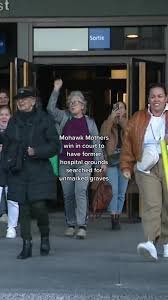
Tio’tia:ke [Montreal]. After obtaining, one year to the day, a precedent-setting injunction halting excavation at the former Royal Victoria Hospital site to search for the unmarked graves of the victims of medical experiments, the Mohawk Mothers, also known as the Kahnistenaera, have won their bid for a safeguard order they presented at the Superior Court of Quebec on October 27, 2023.

On November 20, 2023, Justice Gregory Moore issued a judgment ordering McGill University and the Societe quebecoise des infrastructure [SQI] to abide by the Settlement Agreement they had signed with the self-represented Indigenous plaintiffs on April 6, 2023, and to respect the recommendations of the Expert Panel of archaeologists they had jointly selected. 

Justice Moore’s statement that the SQI’s and McGill’s position ending the Expert Panel’s mandate “does not set a term for the Panel’s mandate on July 17th is “too restrictive,” as the settlement agreement “does not set a term for the panel’s  involvement in the on-going search for unmarked graves” [para. 34]. According to the Judge, “The delay and costs of the overall project cannot justify the SQI’s and McGill’s unilateral reduction of their obligations under the settlement agreement, especially when doing so will cause irreparable harm to the plaintiffs” [para. 39].

For Mohawk Mother kahentinetha, the Judgment is a relief. “We’ve fought so hard for two years to search for these missing children.  Our community was targeted for genocide and our children were used as guinea pigs in these horrific experiments by the CIA to see how to kill the Indian in them.  But since  McGill and the SQI fired the Expert Panel we had no way to keep track and trust the results of the investigation, which was now being controlled by the perpetrators of crimes against our children.  The point in signing of the Settlement Agreement was to allow the Experts to do their job, and we were betrayed. We had to do it all alone without lawyers, facing such powerful institutions. It wasn’t easy but we made it. The Judge understood that the only way this can go is in a professional way, with independent experts to oversee everything and make sure our community is informed”. 

The Mohawk Mothers submitted that McGill and the SQI had failed to implement numerous recommendations of the Expert Panel, notably refusing to share data from the Ground Penetrating Radar surveys, refusing to adopt forensic precaution to protect the chain of custody of evidence, and depriving the Mohawk Mothers of access to crucial information such as contracts with specialists.

Justice Gregory Moore found in favor of the Mohawk Mothers’ argument that the purpose of the Settlement Agreement was to rely on an independent and impartial Expert Panel to provide ongoing recommendations, in order to ensure that the New Vic Project would not result in the desecration of human remains, which survivors and search dogs indicated were on the site.  

In August 2023, McGill and the SQI fired the Expert Panel, one of whom had recently resigned, after they asked to implement forensic measures and peer review data from Ground Penetrating Radar. 

Although Historic Human Remains Detection Dogs had detected the scent of human remains in the area in front of the Hersey Pavilion, McGill and SQI declared that there was no evidence of burials there, suggested it was a false positive, and started large-sale non-archaeological excavation in the zone. The Mohawk Mothers were concerned that development work in the area could start before the source of human remains in the zone was established, especially inside the Hersey Pavilion, because the dogs signalled remains next to the building’s wall and because unexplained demolition work took place there. 

Judge Moore’s court ruling will allow for the independent Expert Panel to provide updated irecommendations regarding the zone and the larger site, after being cut off from the investigation since August. 

On November 5, 2023, search dogs detected the scent of human remains in yet another zone, close to the Allan Memorial institute, where the CIA’s MK-Ultra experiments on brainwashing took place in the early 1950’s and 1960’s.

The parties will be back in court on December 1st 2023. to address a motion ordering the release of records withheld by the defendants. 

The Kanien’kehaka:ka Kahnistensera [Mohawk Mothers] is a Kahnawake based group that helps Indigenous women accomplish their traditional cultural duty  as caretakers of the land, to protect all life, including their children and ancestors. They have been engaged in a legal challenge with promoters of the New Vic project to stall future excavation of the former Royal Victoria Hospital until a proper archaeological investigation is conducted, using the traditional protocols of the Kaianere’ko:wa. [Great Peace].

https:// www.mohawkmothers.csa/Contact for press: kahnistensera@riseup.net [514]463-8835 Kahnawake, P.O. Box 991, Que. J0L 1B0.

In 1990, not so long ago, the kanienkehaka Mohawks defended the land and people which speaks who hears their own way. This is our people. This is our song. It’s about peace:  

Magik Squirrel: Mohawk War Song

MohawkMothers.ca; 

thahoketoteh@ntk.com

mohawknationnews.com

kahnistensers@riseup.net

box 991. kahnawake. que.  canada  J0L 1B0


MCGILL: GLOBAL DEMAND FOR CEASEFIRE IN GAZA


Please post & distribute.


MCGILL TRIBUNE Nov. 2, 2023


PROTESTORS DEMAND UNIVERSITY ACTION AND CEACEFIRE IN GAZA midst growing global movement for Palestine-021120231

https://mohawknationnews.com/blog/2023/11/02/judge-overturns-mohawks-tobacco-conviction/

Content Warning: Mentions of violence, death, antisemitism, and Islamophobia

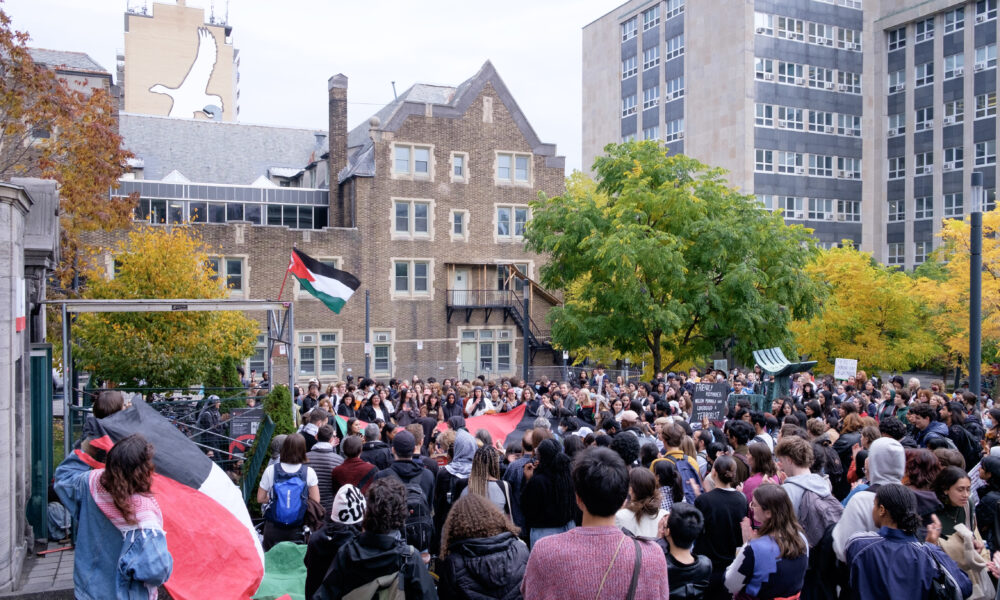
Students flooded out of class at 1:30 p.m. on Oct. 25 to join a growing crowd at the Y-intersection, many donning keffiyehs, waving Palestinian flags, and holding signs in support of the Palestinians in Gaza. The protest eventually moved to the James Administration Building, where members of Students for Palestinian Human Rights (SPHR) McGill blocked the entrance in an attempt to pressure the university to meet their demands.

The protest was part of a wider walkout movement across North America in solidarity with the people of Gaza. In Montreal, SPHR McGill, SPHR Concordia, Solidarité pour les droits humains des Palestiniennes et Palestiniens at Université de Montréal (UdeM) and Université du Québec à Montréal (UQÀM), and Al Raya Dawson partnered to organize and promote the walkout. The organizations listed three demands on their social media platforms: “Divestment from weapons’ manufacturers which arm Israel’s genocide in Gaza,” “an immediate end to Israel’s siege on Gaza and U.S. and Canada funding for Israel,” and “to cease exchange programs with Israeli institutions and cut ties with current and future Zionist donors.”

On Oct. 7, Hamas staged an attack that killed more than 1,400 Israelis and resulted in more than 200 people being taken hostage, according to the Associated Press. Israel has retaliated by launching an extensive bombing campaign, and now ground incursions, in Gaza. Estimates place the Palestinian death toll since Oct. 7 at over 9,000 and the number of people displaced at over 1.4 million, according to Al Jazeera and the Associated Press.

McGill has sent out a series of university-wide statements following the Oct. 7 attack, including one that specifically mentions SPHR McGill, accusing the group of “celebrating violence” on social media and demanding that the group stop using the McGill name. Other McGill communications have encouraged “looking out for each other in sorrowful times” and referenced the university’s Initiative against Islamophobia and Antisemitism (IAIAS)

Protester Salma El emphasized the importance of everyone—not just people from the Middle East—demonstrating support for the Palestinian cause, and called for an immediate ceasefire.

“I am North African, so we’re kind of brothers with Palestinians,” she said. “To be seeing a genocide happening all over again and no one is talking about it just makes you lose hope in humanity, lose hope in leaders. And I just think that maybe, if anything would have happened to Ukrainians, maybe the world would have reacted another way. Just because it’s Palestinians, no one is saying anything.”

As the crowd grew, SPHR McGill organizers started by leading chants and then delivered a land acknowledgement, drawing a parallel between settler colonialism in Canada and historic Palestine. Chants of “FREE, FREE, FREE PALESTINE” and “VIVA, VIVA, PALESTINA” echoed through the centre of campus as a large Palestinian flag was hung on a rolling whiteboard behind the speakers.

Following the land acknowledgment, an SPHR McGill member reiterated the groups’ demands and voiced support for the Kanien’kehá:ka Kahnistensera (Mohawk Mothers)—a group of Kanien’kehá:ka women resisting McGill’s New Vic project over concerns that there may be Indigenous children buried in unmarked graves on the site.

Professor of Arabic Literature Michelle Hartman and representatives from SPHR McGill, Socialist Fightback, and the Palestinian Youth Movement (PYM) addressed the crowd. Organizers then called for the crowd to travel up from the Y-intersection to the steps of the Arts Building as the chants continued.

Organizers led the crowd in cheering, “RESISTANCE IS JUSTIFIED, WHEN PEOPLE ARE OCCUPIED” and “PALESTINE IS OUR DEMAND, NO PEACE ON STOLEN LAND,” followed by chants in Arabic.

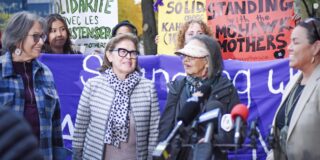
The Mohawk Mothers—who held a teach-in on the archaeological work happening on the New Vic site from 12:30 to 2:30 p.m. in the Leacock building—then addressed protesters from the Arts Building steps, reaffirming their solidarity with the Palestinian cause.

After the Mohawk Mothers’ speeches, protest leaders continued their rallying calls before announcing that SPHR McGill members had blocked the entrance to the James Administration building, and the protest would be walking to meet them. Much of the crowd followed suit and relocated to the site of the sit-in.

At the James Administration building—which hosts various key McGill decision and policy makers, including the Office of McGill’s Principal and Vice-Chancellor, Deep Saini—the crowd swarmed to surround the small group that was occupying the area in front of the entrance, blocking office workers from going in or out. One protestor climbed the scaffolding, planting a Palestinian flag above where the student protesters sat. The Tribune talked to an SPHR McGill spokesperson who was part of the sit-in while it was happening.

“The demand is basically to end this bizarre and angry genocidal campaign that’s being imposed on the people of Gaza right now, and also for our universities to divest from arms manufacturing companies, which are actively funding this regime,” the SPHR representative said. “McGill-specific demands were, of course, to revoke the threats that were made about changing SPHR McGill’s name [….] The threat of revoking our name, it came from a place of this university refusing to associate itself with a policy and student movement, but also to pretend that there is no segment of the McGill population which stands up for Palestine.”

In front of the blocked entrance, various professors spoke out in support of the movement, including associate professor of political science William Roberts, associate professor of Indo-Tibetan Buddhism Lara Braitstein, professor of Islamic Studies Rula Abisaab, and Hartman.

“The administration’s response so far has been timid and cowardly. Generally, the McGill administration cares more about the appearance of civility than about the truth and more about the opinion of a few vocal donors and alumni than about the academic freedom of young scholars,” Roberts wrote in an email statement to the The Tribune after the protest. “I don’t expect that to change. Happily, the students don’t need the administration’s approval or assistance.”

A Palestinian student who wished to stay unnamed expressed the importance of those at McGill and in Canada speaking out.

“It’s important to show solidarity. Especially, you know, we have a lot of privilege here, where we have free speech, we should use it,” they said. “I would like to see the university send an email to us condemning what’s happening to Gazans and also divest from all the money they’re pouring into Israel’s pockets.”

The student, like Salma El, expressed disappointment in the lack of support they’ve received from the school, pointing to the difference between how the university responded to the Russian invasion of Ukraine and the current Israeli attacks on Gaza.

“When everything was going on in Ukraine, they sent a very supportive email to Ukrainian students, they announced their support for Ukraine because it was, you know, being occupied, and they were against it,” they said. “So, it’s not that McGill doesn’t want to be political, it can when it wants to.”

In a statement to The Tribune, McGill Media Relations Officer Frédérique Mazerolle expressed that “Members of the McGill community are free to express themselves and to associate within the bounds set by our university’s Statement of Principles Concerning Freedom of Expression and Peaceful Assembly, Charter of Students’ Rights, and Policy on Academic Freedom.”

“Free association and free expression are rights we affirm. But these freedoms are not absolute, and the words we choose, and how we communicate them, matter. We are staunchly committed to building and sustaining a campus community where our diverse identities are honoured and celebrated, where we are safe to express our identities, and where we can all flourish,” Mazerolle went on to write, echoing an Oct. 8 email sent out by Associate Provost (Equity and Academic Policies) Angela Campbell and Deputy Provost (Student Life and Learning) Fabrice Labeau.

The university did not answer questions pertaining to divestment from companies that support the Israeli military or the state of Israel, McGill’s Oct. 10 email demanding that SPHR McGill stop using the McGill name, or differences between how the Russia-Ukraine conflict and Israel-Palestine conflict have been handled.

While there was a large turnout, some students have expressed concerns about the walkout. A portion of the Mohawk Mothers’ speeches, which was posted on Instagram by SPHR McGill and later deleted, gained traction on X, formerly called Twitter, where users felt it appealed to antisemitic tropes that characterized Zionism as monetization, corporatization, and control. 

“The Kahnistensera stand in solidarity with all oppressed groups,” the Mothers wrote in a statement to The Tribune after the walkout. “When seen through the lens of our own struggles for liberation, it is clear to us that the struggle in Palestine is the same as the struggle of all oppressed groups in the world including Jewish people. The common oppressor is European colonialism.”

“It is very detrimental to consider any criticism of Zionism as a criticism of Judaism,” the group added. “Zionism is not Judaism: it is a modern nationalistic ideology weaponizing antisemitism to displace Jewish people and use them to get rid of Palestinians whom they dehumanize.”

Others pointed to language throughout the protest that they felt lauded Hamas’ Oct. 7 attack and criticized a pro-Palestine sign that depicted the Star of David, a symbol of Judaism, instead of utilizing the flag of Israel or words.

“Antisemites often find their way into anti-Zionist spaces. This goes the other way, too, by the way, there’s anti-Palestinian racism and Islamophobia within right-wing Zionist movements. And it’s on those Zionist movements to stamp that out, as well,” a Jewish student who wished to remain anonymous said to The Tribune after the walkout. “Yet, it is so black and white on campus,  that […] there’s seemingly no room for Jewish allies of ending the occupation, Jewish allies of the Palestinian cause—those of us who want to see an end to violence.”

SPHR McGill did not respond to The Tribune’s request for comment before the publication deadline.

The protest continued until around 6 p.m., with the organizers distributing QR-code petitions in support of the people of Gaza.

Our Arawack brother Bob Marley states it clearly: “Until the philosophy which holds one race superior and another inferior is finally and permanently discredited and abandoned, everyhere is war. Everywhere is war. Me say war. That until there are no longer first class and second class citizens of no nation, until the color of a man’s skin is of no more significance then the color of his eyes. Me say war.’ 

Bob Marley War

TAGS:

JUDGE OVERTURNS MOHAWK’S TOBACCO CONVICTION

Please post and distribute.

Author of the article:

Jason Magder  •  Montreal Gazette Nov. 1, 2023

Judge overturns Mohawk pair’s tobacco conviction, citing centuries-old treaties

A judge found that White and Montour were exercising the rights of the Mohawk nation to direct its own economy.

The Two men won’t face criminal charges thanks to ancient treaties written in the 1600s and 1700s, a Superior Court judge ruled Wednesday.

In a much-anticipated and precedent-setting trial, Judge Sophie Bourque ruled that the Crown was wrong to charge Derek White and Hunter Montour with criminal charges related to smuggling tobacco.

The pair were among 60 people arrested as part of Operation Mygale on March 30, 2016, an investigation into alleged tobacco smuggling from the United States and evasion of millions of dollars in taxes that should have been paid to the provincial and federal governments.

In 2019, White, a former NASCAR driver, was acquitted on one of the two charges of fraud and conspiracy to commit fraud. However, he was found guilty of fraud, conspiracy to commit fraud and profiting from organized crime for not paying federal excise tax on the tobacco that was imported from the United States. Montour was found guilty of aiding organized crime. 

White was facing up to 14 years in prison, while Montour was facing up to five years.

Tobacco is used to communicate with creation.

The pair launched a constitutional challenge to that ruling, arguing that Excise Tax Act tariffs on imports are not applicable to Mohawk people based on Section 35 Constitution Act rights as well as the United Nations Declaration on the Rights of Indigenous Peoples and rights to trade tobacco tax-free.

They argued that the Mohawk nation has the right to control its economy based on ancient agreements with the British colonial powers.

On the other side, the Crown argued that the Covenant Chain was never considered to be a treaty that is protected under the rights of Indigenous people to self-government.In her 365-page judgement, however, Bourque found that the Covenant Chain was still valid, and that it superseded the other 10 treaties. The Covenant Chain concludes that the Mohawk nation has the right to freely develop its economy, she said. This right is inherent for all Indigenous people and it is protected by the Haudenosaunee traditional justice system. She found that White and Montour were exercising those rights, so the criminal charges against them were not valid.She also found that Article 42 of Canada’s excise law was an unjustified violation, giving the Ministry of Revenue a large discretionary power on issuing licences on the tobacco trade without considering ancestral rights.
Bourque said the trial served as an opportunity to re-evaluate ancient agreements with Indigenous communities in light of Canada’s adoption of the United Nations Declaration on the Rights of Indigenous Peoples, the Universal Declaration of Human Rights and the Truth and Reconciliation Commission.
The trial lasted from October 2021 to April 2022. It took Bourque an additional 18 months to render her judgement. The ruling is considered to be an important and precedent-setting one, and as such it may be appealed.

jmagder@postmedia.com

twitter.com/jasonmagder

Message to the government of Canada comes from our great friend, Willie Nelson: “Say goodnight, the party’s over”. 

https://www.youtube.com/watch?v=xR2xuvKldok

 mohawknationnews.com

MohawkMothers.ca

boc 991 kahnawake que. canada J0L 1B0

thahoketoteh@ntk.com

kahentinetha2@protonmail.com

MOHAWK MOTHERS DISPUTE DISBANDMENT OF EXPERT PANEL

Please post & distribute.

MNN. Nov. 1, 2023.
https://www.thetribune.ca/news/kanienkehaka-kahnistensera-appear-in-court-discuss-disbandment-of-archaeological-panel-31102023/

The Kanien’kehá:ka Kahnistensera (Mohawk Mothers) appeared at the Montreal Courthouse for a five-hour case management hearing on Oct. 27. The hearing came as part of the Mothers’ ongoing investigation into McGill’s New Vic Project site—where the Mothers fear that there may be unmarked Indigenous graves—alongside McGill, the Société québécoise des infrastructures (SQI), the Royal Victoria Hospital (RVH), the City of Montreal, and the Attorney General of Canada.

The Mothers gave the first statement before Justice Gregory Moore. Beginning with Mohawk Mother Kwetiio, the Mothers urged the court to enforce the settlement agreement, which, in Kwetiio’s interpretation, states that all parties are bound to the recommendations of the court-appointed expert archaeological panel. Kwetiio further alleged that McGill had sent contracts to the three members of the panel—which disbanded on Aug. 3—with three-month termination dates. The Mothers were not informed of these contracts until they had already been signed and were irreversible.

Kwetiio argued that Ethnoscop—the archaeological firm hired for the investigation—did not use appropriate methods to protect the forensic chain of custody of any potential evidence, as they were touching evidence with their bare hands and not using tamper-proof bags. She also stated that the defendants were strategically choosing which information they would share with the Mothers in order to continue the investigation without delays.

“There’s been a lot of cherry-picking of what [the defendants] are going to use to help themselves to further their construction, and not the investigation,” Kwetiio said in a press conference after the hearing.

The court then heard from Mohawk Mother Kahentinetha, who shared that potential anomalies were excavated on the site in rapid time which did not allow for proper significance and care to be given to each anomaly. She said that on one day, nine anomalies were excavated with a mere 45 minutes allotted to each anomaly. Kahentinetha claimed that the soil was not sifted properly, and any bone fragments found were immediately deemed to be of animal origin.

In a written statement to The Tribune, the SQI asserted that all excavation is being carried out in accordance with proper archaeological regulations by expert firms, with proper methods used to ensure soil is not mixed or contaminated.

Kahentinetha also shared that after facing verbal assault from SQI security guards on July 25, the Mothers had asked to be accompanied by Indigenous security personnel from T.D. Security while onsite. However, it took three weeks before the defendants complied with this request.

Kwetiio continued, asserting that the Mothers deserve to be treated with respect on the site and should not be subjected to “uncontrollable anger” from the defendants when they ask questions. She ended the Mothers’ statement by contending that the defendants had breached every part of the settlement agreement.

The court took a fifteen-minute break, after which Julian Falconer—the lawyer for the Office of the Independent Special Interlocutor, Kimberly Murray—gave his statement, alleging that the defendants were being denialistic. He stated that the Mothers already had an insurmountable burden placed on them throughout this case, and this burden had “quadrupled” the day the panel was disbanded. He condemned the disbandment of the panel and alleged that McGill and the SQI had replaced the panel with their own archaeological experts so that they could inform the public that they were relying on the advice of experts.

“Today was about bringing back the experts that know how to do this work, to find unmarked burials,” Murray said in a press conference after the hearing. “We have a lot of companies that can do scans. We don’t have a lot of people that have expertise in analyzing the data.”

Later, the court heard from the SQI. Their statement was delivered in French and translated for the Mothers by anthropologist and associate of the Mothers Philippe Blouin. Members of Take Back Tekanontak—an advocacy group in support of the Mohawk Mothers—were stationed outside of the courthouse after the hearing to show solidarity. In an interview with The Tribune, an organizer of Take Back Tekanontak, Diane, who chose not to give her last name, shared her belief that the lack of a court-provided English translation of the SQI’s statement for the Mothers was appalling and oppressively exclusionary.

“The Kanien’kehá:ka Kahnistensera come to court, and they speak Kanyen’kéha, their own language, and their colonial language is English,” Diane said. “It’s not okay to ask them to learn French as a second colonial language, and yet there is no translation provided for them. I cannot believe my eyes.”

McGill’s lawyer, Doug Mitchell, provided the next statement before Justice Moore. He stated that the university believes that it has abided by the settlement agreement wholly and respectfully, arguing the occasional disagreements between parties are not an indication that the agreement is being violated. He asserted that the defendants are bound by the recommendations of techniques by the panel, not to anything else.

Mitchell additionally claimed that Falconer had “theatricized” his speech to the court so that Justice Moore would rule in the favor of the Mothers.  He stated that the Mothers needed to take the emotion out of the investigation, alleging that the Mothers and Murray only wanted to enforce their interpretation of the contract and were not suffering any irreparable harm by the way McGill was carrying out the investigation.

Falconer responded to Mitchell’s statement, saying that Mitchell should apologize for asking the Mothers to be less emotional about the investigation. He also argued that all parties should acknowledge that the panel’s recommendations have not been followed, as the panel itself believes its suggestions have not been entirely executed.

“It is absolutely essential that McGill, the Quebec government, [and the] SQI come to their senses and understand that it is very short-sighted to essentially terminate a panel they agreed to be bound by in order a further a development,” Falconer said in a press conference after the hearing. “I promise you, whatever few dollars [the defendants] make on their development, the [societal cost] and the [further erosion] of trust is absolutely innumerable in terms of the size of the expense.”

Kwetiio also replied to Mitchell’s statement, stating that Mitchell’s words were “deeply offensive,” and reiterating the fact that all parties would not be back in court if the recommendations of the panel had been respected.

“I think it was pretty disgusting that the defendant said ‘Oh, there’s no irreparable harm done here.’ […] There’s never a situation where any one of us is going to bargain without children of the past, present, and future,” Kwetiio said in response to Mitchell’s comment in a press conference after the hearing.

Justice Moore adjourned court with no decision made, explaining that he would need some time to review all submissions and testimonies. McGill media relations officer Frédérique Mazerolle told The Tribune in an email that McGill will provide a comment on the hearing once Justice Moore makes a decision. A tentative subsequent court date is set for Dec. 1, during which all parties will discuss the issue of archives and records related to the investigation.

“We demand that we have a proper best practice investigation for our children and for those that were disrespected on that site,” Kwetiio said. “I think our children are looking for us to find them, and this is what’s important, and I’m so glad that all these people are here today in support.”

Led Zeppelln knows the way of betrayal; “Lying, cheating, that’s all you seem to do. Messing around with every guy, putting me down for thinking of someone new . . . Your time is gonna come. Your time is gonna come. Your time is gonna come. Your time is gonna come. . . . 

Led Zeppelin - Your Time Is Gonna Come (Official Audio)
KIMBERLY MURRAY SPEAKS:

DESKAHEH WENT TO GENEVA IN 1923 FOR THE SOVEREIGN ROTINOSHONNI PEOPLE

MNN. Sept. 21, 2023.

REMEMBERING THE ARGUMENTS OF DESKAHEH

FOR THOSE WHO FORGOT WHY HE WENT TO GENEVA.

THE REAL FACTS!
ERAKWA DIPLOMACY 1710
IROQUOIS DIPLOMACY 1710

IERA’KWAH EXPLAINING TEIO’HATEH/TWO ROW IN EUROPE.

1.OPENING. Canada’s Royal Commission on Aboriginal Peoples now admits that the relationship between the indigenous people and the uninvited Europeans began with the teio’hateh, Two Row Wampum agreement. Two entities agree to live separately according to the kaianerekowa, the great peace, or leave. We allowed them to live here temporarily – with us in our canoe and they in their ships. We would share only the river. The indigenous peoples and the newcomers belonged to different families with different languages, culture, laws and ways of life. Europe’s monarchs acknowledged we were not their subjects and they could not interfere with our laws and customs. As turtle island is all indigenous land, we provided to the European “social groups” the use of land the depth of a plow to grow food. They could never own it or form a political party. They needed our permission to do anything on our land.

THE ORIGINAL INHABITANTS WERE CLAN BASED WITH TIES TO THE LAND. 


2.FORGETTING TWO ROW. Then the colonizers began to see things their foreign way. They violated the Two Row and adopted a “geographic” description of themselves, that they were North Americans. The original inhabitants were clan based tied to the land. The colonizers fought with their European cousins over who could come here, which is our right. Then they started to impose their military laws and ways on everyone on turtle island based on the treaties the Europeans made to end their wars with each other in Europe. [Seven Years War and others]. They never consulted the onkwehonweh, the original peoples who had always respected the land since time immemorial. Instead of staying in their own ship they decided to take over the whole river.

3.DOMINION “CLAIMS’. Some of Britain’s North American colonies confederated in 1867 to form the colony of CANADA. The new political organization was a “dominion”, a colony, because the visitors decided they had a right to dominate the land and all the indigenous people on it. Instead of subjects of their king or queen, they began to base their identity on the indigenous land they were squatting on. They changed from accepting our generosity to trying to dominate us. 

4.BRITISH SUBJECTS. There was no permission from us for this assertion of power. Canada was a British colony and Britain could not give her subjects here anymore than she had to give, which was nothing. The British subjects ignored the Two Row. Britain could not give their subjects on turtle island the right to make laws for the indigenous people because we were not British subjects. At that point they had to leave as they had become trespassers.

5.GEOGRAPHIC DEFINITION. Our ancestors were not consulted about these moves. They knew we could never change the terms of the Two Row. Our land belongs to the unborn. We are the caretakers of mother earth. She cannot be sold or conveyed to anyone and is governed by the kaianerekowa, the great peace. The land was provided by creation to our past present and future generations.  Britain’s colonial subjects had no right to force Indigenous peoples into their European territorial concepts of nationality and property. They could not impose their new geographic definition of themselves on us. 

6.INDIGENOUS FREEDOM. The colonists are still subjects of their kings. Indigenous are not, never were. and never will be. The  life of being free and having a voice was a revelation to Europeans. We are all sovereign persons and part of our own nations and clans. We were each sovereign persons placed by creation in various areas of turtle island to carry out our duties to our mother earth and all life.

7.OUR VOICE. The colonists didn’t want to be subjects anymore. They changed their view of law and international relations. Today Europeans have formally embraced equality along with the rest of the world. Britain no longer has subject status. The colonists define “nationality” on usurp territorial terms rather than adhering to the kaianerekowa, the great peace.  Without our knowledge or consent their citizenship became based on place of birth undermining the kaianerekowa. They still do not grasp the full meaning of equality. Their institutions don’t give their citizens a voice. Their First Nations Governance Act shows that they don’t respect the voice of the indigenous people who have had total jurisdiction of this land since time immemorial. This Act of 2002 was proposed to municipalize native land under private banks and extinguish the sovereign original people.  [Today it is the proposed “Framework Agreement”.] They completely ignored their obligations under the Two Row Wampum.

8.REAL INDIGENOUS IDENTITY. The colonizers can change the way they think of themselves as long as they adhere completely to the great peace here. They cannot define our identity nor appropriate our land and resources. Since Confederation Britain’s colonial subjects have been violating Britain’s agreements with the Indigenous peoples.

9.CORPORATION CAN’T OWN THE LAND. Confederation and the British North America Act 1867 did not give Britain the right to let its colonists violate the Two Row Wampum. Britain knew that its people could only come onto our land as a separate “social group” that would share the river with us. But Britain’s subjects fell into the illusionary idea that they owned the land. This lie is taught in their indoctrination centres called the education system. 

DESKAHEH 1923

10.DESKAHEH & S.C.C. The iera’kwa, the Six Nations Iroquois Confederacy knew this back in 1920. In desperation they sent Levi General Deskaheh to ask the Supreme Court of Canada to stop the Department of Indian Affairs from violating the British North America Act 1867. This Act only gave Canada the right to negotiate with us in place of Britain. the colonists cannot impose their Admiralty laws on indigenous people. But Canadian officials would not let Deskaheh have his day in court.

11.TROOPS ATTACK SIX NATIONS. If Deskaheh was allowed to prove that what they were doing was illegal, these bureaucrats would have been out of work.  So they sent troops, the RCMP, to invade the part of Six Nations Grand River territory that remained after a century of theft and fraud. The military deposed the traditional government, the oldest governments in the world, installed their band council puppets and stole all our land and created the Indian reservation on October 25, 1924. [Indian Lands Act]. *Since then the colonists have refused to deal with the real traditional leaders, speaking only to their faux elected band councils they have imposed under colonial laws.

12.DESKAHEH & LEAGUE OF NATION. Six Nations diplomats had been honoured guests in Britain’s courts. By the 1920’s Britain was refusing to deal with the problems that had befallen their colony. The Iroquois Confederacy sent  Deskaheh to the League of Nations to appeal for justice. The sovereign Six Nations, iera’kwah, were qualified to join and wanted membership in this new international organization so our arguments could be presented to protect our legal rights. The Netherlands, Persia, Estonia, Panama and Ireland all agreed that the Six Nations complaints should be examined by the international court. But Deskaheh was ambushed again by Canadian officials lead by D.C. Scott skulking behind the scenes to make sure the case never got a formal public hearing. They lied to the League saying  there was no Two Row and no Great Peace.

The Lands Act is part of the Indian Advancement Act 1924 that imposed the blood quantum legislation [apartheid].  It was the 100 year “business plan” to extinguish the native people, due for completion in 2024.

13.INDIGENOUS ARE ALLIES. Today, the colonists know we indigenous will always maintain our right to independence. We were allies, not subjects of Britain. We are not part of the Corporation of CANADA – the colony that became a corporate successor state. The colonists imposed foreign Admiralty laws on us in violation of both the Two Row and modern International law. They imposed their economic sanctions upon us that have put us in a state of destitute poverty compared to all the colonists. As Deskaheh put it in his last address before he was assassinated in 1924, it’s as if Mexico tried to apply its laws in the United States. 

14.MEANING OF EQUALITY. The problem is European colonists don’t understand the meaning of equality. They have changed how they define themselves. When we made the Two Row Treaty with France and then Britain a month later, we both defined ourselves in terms of ‘personal’ relationships. We are sovereign individuals who are part of our clans. European nations are based on subject status and their allegiance to their monarch. Their shift to a turtle island territorial definition of themselves has no legal basis. They have no right to impose themselves or their laws on us or to take our land and resources without our knowledge or consent. As a successor state, the colonists are still bound by Britain’s treaty obligations. The colonists are guests on our land. Instead they have presumed to take over our whole house. The colonists must work out fair and valid agreements with us, the original inhabitants of turtle island, to our satisfaction if they want to remain here.

15.CANADIANS ARE IMMIGRANTS. The colonizers celebrate “Canada Day” aware that CANADA is a corporation, not an independent nation. Canadian nationality does not exist. Nationality is tied to having clans, shared ancestry, native language, not two foreign languages, a traditional culture and land. CANADA has none of these.  The settlers and their ancestors have in common fleeing from oppressive regimes and immigrating onto someone else’s land and then oppressing them. We have no obligation to care for them. They never accepted the protection under the great peace, which alienated them. 

16.DOMINION FEUDAL CUSTOM. Canada is a “dominion” that was produced by Britian’s will to dominate. “Dominion” is a feudal custom carried to Britain by foreign lords who conquered the land and the people on it. These deeply rooted cultural habits violate the egalitarian respect represented by the Two Row Wampum.

17.CANADA NON-EXISTENT. Consequently, the whole existence of Canada as a legal country is the biggest ruse played on the world. The colonist’s self-definition cannot appropriate our political identity, our resources and our land. This violates the initial treaties made by Britain with the Indigenous peoples. 

18.CANADA VIOLATES NATIVE AND INTERNATIONAL LAW. The colonists violate both the European version of international law and our Indigenous law. The colonists violate the principle of human equality, which they now recognized in a formal way in the mid-twentieth century – after the atrocities of World War II – when they signed the Universal Declaration of Human Rights, the Charter of the United Nations and the International Covenant on Civil and Political Rights. Canada hesitates to ratify UNDRIP UN Declaration on the Rights of Indigenous Peoples as it recognizes that Canada is not a country. The immigrants would have to vacate, CANADA would dissolve and the great peace would be the only law that would prevail.  

19.MIGHT DOES NOT MAKE RIGHT. Deskaheh tried to present this argument in the 1920’s but the colonists didn’t want to hear us explain once again  our demands for them to respect our jurisdiction over our land and our political and economic rights. We are sovereign and they are not! When Americans had their revolution they threw off their subject status. Then they went crazy, grabbing land, killing people and destroying resources. They called us the natural people “Indians” and treated us as vermin. Canadians accepted the American policy that “might makes right” and that Europeans had a god-given right to grab lands, possessions, resources and lives. Canada bought into the sleazy American dream. This premise applies to all of the Americas, north and south.

20.INDIGENOUS HAVE EVERYTHING. What happened was sordid. In the subsequent treaties on the prairies there was no meeting of the minds with the native people there. Anglo-Canadians pretend those people agreed to give up everything they had! The indigenous are aware of the agreement to co-exist with them as social groups. In our case the Two Row created a real meeting of minds. The British recognized that we are nations that give permission for anybody to live here according to the great peace. It’s still in effect.

21.TERRITORIAL DEFINITION. The Anglo-Canadian one-sided decision to shift to a territorial definition of themselves gave them no right to take over our land and resources. They have no agreements with us the real natural indigenous. Their corporate Canadian band councils are on the enemies team. They need our consent to our full satisfaction to do anything on our land. We won’t succumb to their lust for our resources or to ransack our land. It’s all ours and they all know it.

22.WHERE’S RECEIPT FOR TURTLE ISLAND. The colonists purport that all people are equal, at the same time illegally imposes laws and beliefs on us. As a successor state Canada is still bound by the limitations of Britain’s treaty obligations which they must fulfill. They would have to leave, or leave us alone or abide by the great peace. Since whites don’t have clans, they are disqualified from living here. They can only live here as a separate social group under the authority of the clans established by the great peace. This is international law which Canada agreed to. The colonizers have no legal right to claim dominion over the inherent original people, or to take our lands and possessions. They have not worked out fair and valid agreements with us that consider the rights of our people now and into the future. We are the “people of the forever” placed by creation on mother earth. Canada’s current attempts to force us original people to prove in their foreign private courts that we have a claim to our own lands is ridiculous and unlawful by international law. They must show us their permits to be on our land, to ransack our resources and to leave a trail of blood and pollution behind. The colonists have no receipt for our land. 

What part of the “depth of a plow share” don’t these alien invaders understand? All these points apply equally to the United States. Only the foundation of the great peace and two row of equality, having a voice through concensus, justice and truth can eliminate the current pandemic of hatred, injustice and racism that is tearing up the world. 

The rotinoshonni are awaiting an invitation from McGill to deliver this speech again. 

In 1924 Duncan Campbell Scott set up the whole concentration camp POW/reserve and apartheid system. October 25, 2023, is the 99th year of the 100 year “business plan” to rid Canada of the indigenous problem. We are standing strong even though our hands are bound. Canada should be more concerned about their own dissolution. Upon intruding turtle island, the ratinaraken were welcome to follow “The white roots of peace” and sit under the shade of the tree of peace.  Fellow Mohawk Robbie Robertson does it so well bridging the people of the world together with this song:

MNN Mohawk Nation News thahoketoteh & kahentinetha2@protonmail.com  For more news and to sign up for MNN www.mohawknationnews.com  More stories at MNN archives.  Address:  Box 991, Kahnawake [Quebec, Canada] J0L 1B0

The Indian Lands ACT. 1924. file:///Users/kahentinetha/Downloads/IndLanAct1924.pdf

Six Nations Appeal to League of Nations 1922-31 http://historybeyondborders.ca/?p=189

MohawkMothers.ca 

Privacy Overview

This website uses cookies so that we can provide you with the best user experience possible. Cookie information is stored in your browser and performs functions such as recognising you when you return to our website and helping our team to understand which sections of the website you find most interesting and useful.